
Introduction
The pass-through deduction, also known as the Qualified Business Income (QBI) deduction under Section 199A, has become a major tax advantage for many business owners, including real estate investors. Recently, this deduction was made permanent, giving property owners a reliable way to save on taxes while investing.
If you own rental properties, triple-net (NNN) leases, or are thinking about 1031 exchanges, understanding how to use the QBI deduction can save you thousands each year. This article breaks down the most important updates for 2025 and shares strategies to help you maximize your deductions, all explained in simple terms.
New Phase-In Limits & Inflation Adjustments
According to a study, The OBBB keeps the QBI deduction at 20% but tweaks the phase-in limits for high earners. For 2025, the taxable income threshold for married couples filing jointly is $383,900, and for single filers, it’s $191,950. Above these, the deduction phases out unless you meet wage or unadjusted basis immediately after acquisition (UBIA) tests. The OBBB also introduces an inflation-adjusted minimum deduction of $400 for taxpayers with at least $1,000 of QBI from active businesses (Reuters, Jul 1 2025). This ensures even small-scale landlords can benefit.
| Filing Status | Threshold Income | Phase-Out Range |
| Married Filing Jointly | $383,900 | $483,900–$583,900 |
| Single | $191,950 | $241,950–$291,950 |
If you earn below these limits, congratulations, you get the full deduction! If not, you’ll need to focus on wages paid and property investments to maximize what you can deduct.
Aggregation Rules for Multiple Entities
Many property owners hold different properties in separate LLCs, partnerships, or corporations. The good news is, the IRS allows you to combine or “aggregate” these businesses under certain rules for the QBI deduction.
When can you combine?
You can elect to aggregate if:
- You own at least 50% of each business.
- The businesses are related — meaning they provide similar services, share management, or operate in related fields.
Why does this matter? When you combine your businesses, you can:
- Pool wages paid across entities to meet the minimum threshold required for full deduction.
- Combine property investments to increase the deduction limits.
- Simplify tax reporting and reduce the chance of losing part of your deduction.
But keep in mind: Aggregation means your records across businesses need to be consistent, and it can sometimes draw more IRS attention. It’s a good idea to talk with your CPA before deciding.
Wage and Property Investment Planning for Triple-Net Properties
Triple-net (NNN) leases are popular because tenants cover property taxes, insurance, and maintenance. They provide steady, passive income. But when it comes to QBI deduction, things can get tricky.
Why? Because if you don’t pay wages or have a significant investment in property, your deduction may be limited if your income is high.
What counts for the QBI deduction?
- Wages: The amount you pay employees or contractors matters.
- UBIA (Unadjusted Basis Immediately After Acquisition): This is basically the original cost of your property (minus land) used in the business.
If your income is above the thresholds, you need to have enough wages paid or property value (UBIA) to keep the deduction.
How to plan around this?
| Strategy | What it Means |
| Hire employees or contractors | Property managers or maintenance staff count as wages, which helps you qualify for a bigger deduction. |
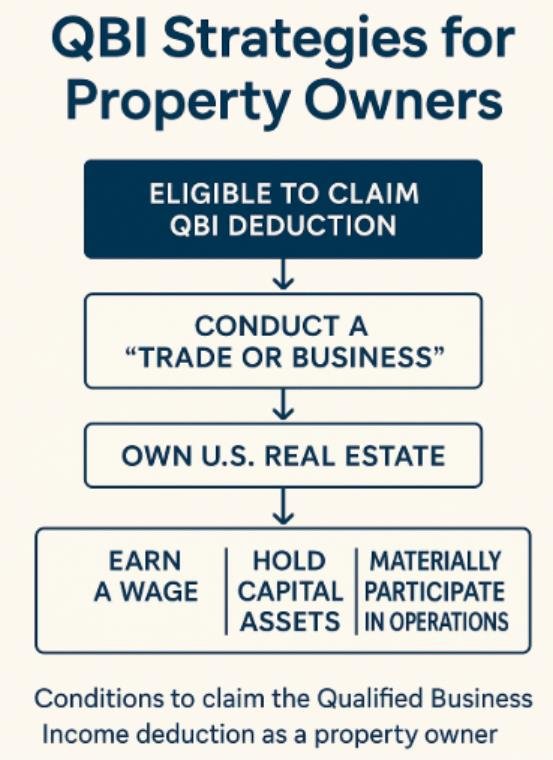
| Use IRS Safe Harbor election | This allows qualifying rental properties to be treated as businesses for QBI purposes. |
| Invest in property upgrades | Buying bonus depreciation–eligible property can increase your UBIA and help your deduction. |
For example, if you earn $300,000 from a triple-net property but don’t pay any wages, your QBI deduction may be cut back. Hiring a property manager or contractor can increase wages and help you qualify for more of the deduction.
Combining QBI Deduction with Bonus Depreciation
Bonus depreciation allows investors to deduct 100% of the cost of qualifying property in the year it’s placed in service. Thanks to recent tax changes, this is now permanent for property acquired through 2026, with a phase-down starting in 2027.
What does this mean for you?
- You can write off a big chunk of your investment right away, which lowers your taxable income.
- However, lowering taxable income too much can reduce your QBI deduction since it’s based on business income.
- You’ll want to balance how much bonus depreciation you take with your overall tax and QBI deduction goals.
Helpful tips:
| Tip | Explanation |
| Use cost-segregation studies | Break your property into components to accelerate depreciation and maximize deductions. |
| Time your purchases carefully | Try to place property in service before the end of the year to maximize bonus depreciation. |
| Consult your CPA | Make sure you understand how depreciation impacts your QBI deduction and overall taxes. |
Recent data shows that real estate investors who combine cost segregation and bonus depreciation strategies save on average 25% more in taxes than those who use standard depreciation.
Frequently Asked Questions
- What counts as qualified business income (QBI) for real estate investors?
QBI includes income from your rental properties or businesses that meet IRS rules. Passive rental income from NNN leases can qualify if structured correctly, especially if you aggregate multiple businesses or meet safe harbor rules. - How do wages and property value affect my QBI deduction?
If your income is above certain limits, the IRS requires you to have enough wages paid or property value to qualify for the full deduction. Hiring employees or investing in depreciable property can help you meet these requirements. - Can I deduct bonus depreciation and still get the QBI deduction?
Yes, but bonus depreciation lowers your business income, which may reduce your QBI deduction. It’s a balancing act best done with your CPA’s advice. - How do I combine multiple businesses for the QBI deduction?
You can elect to aggregate if you own at least 50% of each business and they operate in related fields with some shared management or facilities. This can increase wages and property value counted toward your deduction. - What changes did the Inflation Reduction Act (OBBB) bring for real estate investors?
It made 100% bonus depreciation permanent through 2026, allowing real estate investors to deduct the full cost of eligible property quickly, helping with tax planning and cash flow. - What is the IRS safe harbor election for rental real estate and how does it help with the QBI deduction?
The IRS safe harbor lets qualifying rental real estate enterprises be treated as a trade or business for QBI purposes. This means if you meet certain criteria like maintaining separate books, performing at least 250 hours of rental services annually, and keeping proper records. By this you can claim the QBI deduction on your rental income more easily, even if it’s passive. - How does the “replacement property 45-day rule” impact 1031 exchanges and QBI deductions?
The 45-day rule requires investors to identify potential replacement properties within 45 days after selling their original property in a 1031 exchange. Choosing the right replacement properties that qualify for QBI deductions, like NNN properties or bonus depreciation-eligible assets, can maximize your tax benefits during the exchange.
Final Thoughts
Tax laws around real estate investing can be complex, but the permanence of the Section 199A pass-through deduction means you can plan with more confidence. Using smart wage planning, aggregation strategies, and bonus depreciation can save you money and boost your investment returns.
Ready to Invest?
If you want to find 1031 exchange properties for sale, including single-tenant NNN investment opportunities or DST 1031 listings under $1M, 1031 Deal Hub offers a trusted marketplace tailored to real estate investors like you.
Ready for passive income? Visit 1031DealHub.com to browse NNN 1031-eligible properties now.
DISCLAIMER
I am not a CPA, attorney, broker-dealer, or investment adviser. This content is for general education and must not be relied upon for tax, legal, or accounting advice. Always consult your licensed professional. Federal and state rules change frequently; info may become outdated. Circular 230 Notice: Nothing here is intended for, nor can it be used for, avoiding U.S. tax penalties.
Advertising Disclosure. Posts may reference services offered by AMC Real Estate Investment Services and affiliates, including 1031DealHub.
Forward-Looking Statements. Any opinions or projections are based on current data and may change without notice.